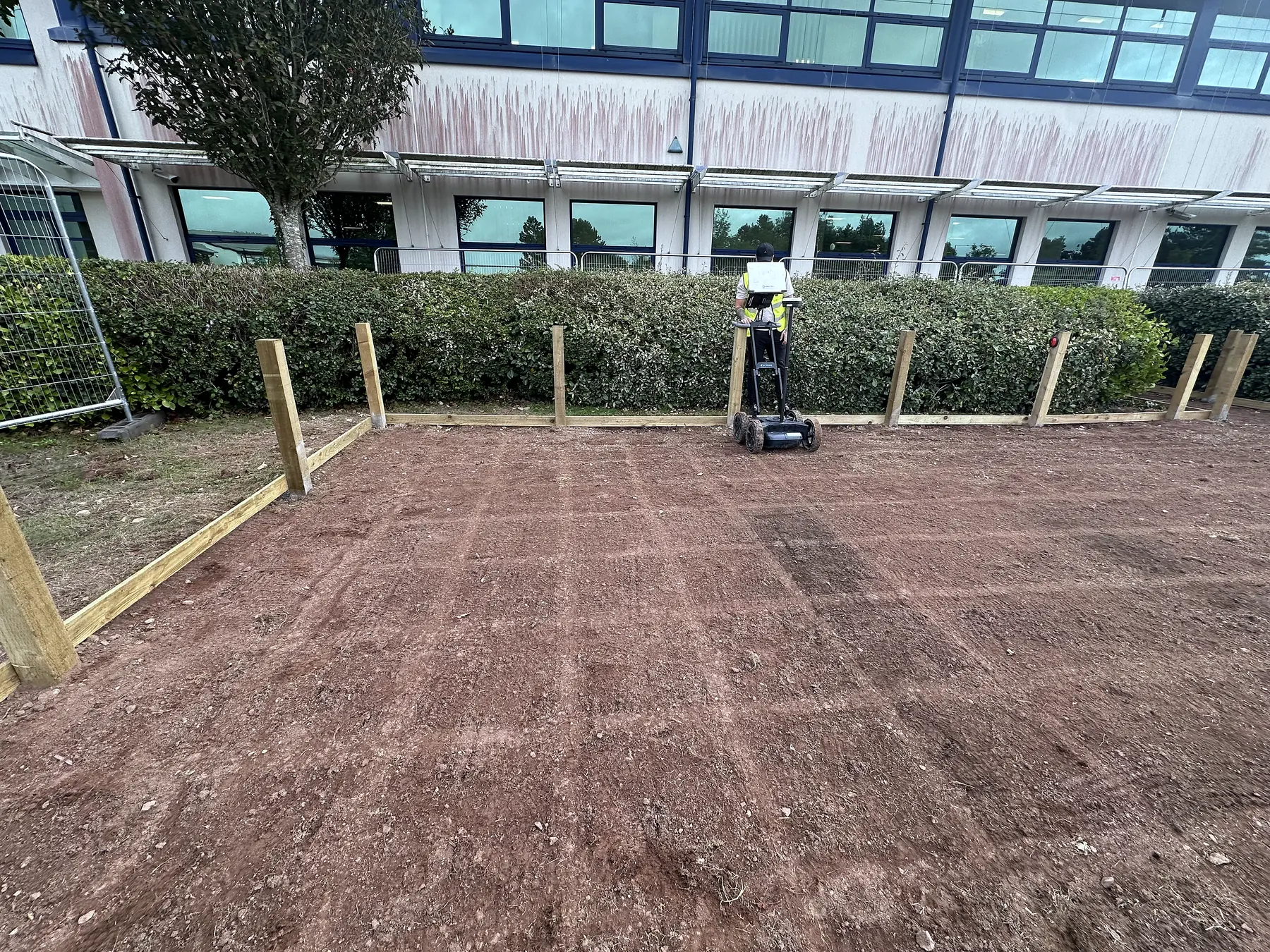
CAT and Genny Survey
A quick electromagnetic sweep for energised cables and metallic pipes, honestly described.
A service-avoidance scan, honestly described.
What it is
A CAT and Genny scan is a quick electromagnetic sweep to find energised cables and metallic pipes before a small excavation. It is fast, it is cheap, and it is not a PAS 128 survey. We will do one when it is the right tool and tell you when it is not.
What it finds, and what it does not
It finds live power, signal-carrying telecoms, and metallic pipes we can clip a signal onto. It does not find plastic water or gas, clay drainage, dead cables, or anything the locator cannot energise, and it gives no reliable depth without a GPR pass.
When it is enough
Small hand-dug excavations, post holes, and trial pits where the records are good and the ground is open.
When it is not
Machine excavation, piling, anything with plastic gas or water nearby, and anything a client has asked to be PAS 128.
Upgrade path
The same visit becomes a Type B with a GPR pass and a records search. That adds a records pack, a second method, positioning and a drawing with a quality level on every line, so it adds time and cost. A CAT and Genny sweep is a few hours; a Type B is one to three days on site plus office processing.
Is a CAT scan enough for the HSE?
Not by default. HSG47 expects a safe system of work for the excavation, based on the risk assessment, the available records and a suitably competent scan. Whether a CAT and Genny scan is enough is a judgement on your risk assessment, not a yes. If the risk is anything above a small hand dig in open ground, specify a Type B.
Where it helps
- Before excavation, piling, trenching or ground anchors
- Before a basement dig or a pavement opening in a London street
- Where the statutory records are old, incomplete or contradict each other
- On a site with a history of services being added and abandoned
- When the client or principal designer has specified PAS 128
- Before EV charger, district heating or substation works
What you receive
- Marked-up ground in survey paint, colour-coded by service
- Utility drawing in DWG/DXF and PDF, each line labelled with type and PAS 128 quality level
- Report stating survey type, methodology, kit, operator qualification and limitations
- Records pack from the Type D search
- Within 5 working days of the site visit
A note on interpretation. A PAS 128 survey records what was detected to the stated quality level. It does not guarantee that every service has been found. Safe digging practice, trial holes where the drawing says QL-B3 or B4, and HSG47 still apply.
Often surveyed together.
GPR Concrete Scanning
Ground penetrating radar finds rebar, post-tension cables, conduits, and voids hidden inside concrete, before they become a problem.
Learn moreFerro Scanning
Electromagnetic scanning to map reinforcement, measure cover depth, and estimate bar diameter without touching the concrete.
Learn moreMore from PAS 128 Utility Surveys.
- PAS 128 Utility SurveysPAS 128 Explained
The British specification for finding and recording buried utilities, in plain English.
- PAS 128 Utility SurveysType B Detection Survey
Two detection methods over the whole area, every service positioned and labelled with how confident we are.
- PAS 128 Utility SurveysGPR Utility Survey
Why GPR is the second detection method, what it finds that a locator cannot, and where it struggles.
Got a dig coming up?
Send drawings, photos or proposed fixing locations and we'll advise the right survey approach.